Organised by
SCHOOL OF ELECTRICAL ENGINEERING
In Association with

About the Institution
Sri Lakshmi Ammal Educational Trust was established with a visionary mission to transform higher education in Tamil Nadu. In 1984, under the dynamic leadership of Dr. S. Jagathrakshakan, the Trust founded the Bharath Institute of Science and Technology (BIST), marking a historic milestone as the first self- financing engineering college in the state. This pioneering initiative laid the foundation for the Trust’s future ventures in medical, dental, and allied health sciences education.
Continuing its commitment to academic excellence, the Trust established Sree Balaji Dental College and Hospital in 1989. The institution rapidly gained prominence and, in July 2002, was granted the status of a Deemed to be University by the Ministry of Human Resource Development (MHRD), Government of India, under Section 3 of the UGC Act, 1956. This recognition marked the birth of the Bharath Institute of Higher Education and Research (BIHER), under the ambient of which a growing network of prestigious institutions has flourished.
Together, these institutions reflect the Trust’s unwavering dedication to providing world-class education. Today, BIHER stands as a premier educational conglomerate, offering multidisciplinary, multicultural, and high-quality education to nearly 20,000 students every year from across the globe.
ABOUT THE SCHOOL
The School of Electrical Engineering, established in 1992, offers two undergraduate programs — B.Tech in Electrical and Electronics Engineering (EEE) and B.Tech in Electronics and Communication Engineering (ECE). In 2003, six postgraduate programs were introduced, followed by Ph.D. programs in both disciplines.
The Department of Electrical and Electronics Engineering (EEE) focuses on power systems, renewable energy, power electronics, control systems, and electric mobility, with advanced laboratories supporting research in embedded systems, power converters, and sustainable energy technologies. Students are encouraged to engage in research and industry-based projects to enhance technical skills. The Department of Electronics and Communication Engineering (ECE) emphasizes communication systems, wireless networks, VLSI design, and the Internet of Things(IoT), offering cutting-edge facilities and a strong research culture that drives innovation in intelligent electronic systems.
Both B.Tech (EEE) and B.Tech (ECE) programs are ABET-accredited, ensuring global standards in education. The school is known for its modern infrastructure, qualified faculty, and research excellence in teaching and service. With strong industry–institute collaborations through consultancy, training, and research projects, the school bridges academia and industry. It fosters a competitive learning environment, motivating students to excel in GATE, CAT, GRE, and TOEFL, while offering excellent placement support that ensures success in academia, industry, and research.
About The Conference (GCSESEIC-2025)
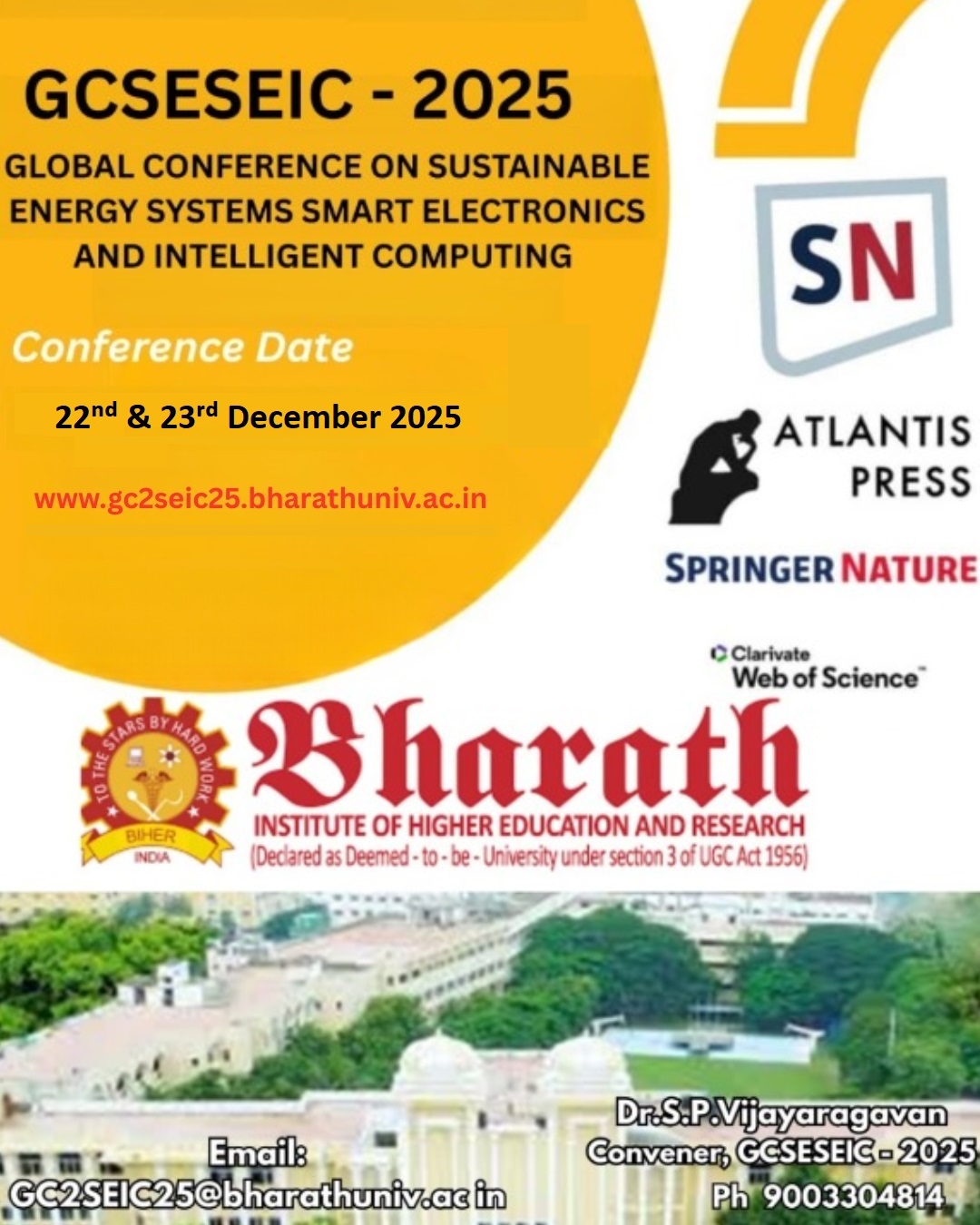
Global Conference on Sustainable Energy Systems, Smart Electronics and Intelligence Computing (GCSESEIC-2025) Organized by the School of Electrical Engineering
The Global Conference on Sustainable Energy Systems, Smart Electronics, and Intelligent Computing (GCSESEIC-2025) is a prestigious international platform dedicated to fostering the exchange of knowledge, ideas, and innovations among researchers, academicians, industry professionals, and students worldwide. The conference provides a stage for innovators to deliberate on the latest research trends, practical challenges, and transformative solutions spanning the interconnected domains of Electrical, Electronics, and Computing systems. Hosted by the School of Electrical Engineering, this conference aims to strengthen interdisciplinary collaboration and inspire cutting-edge research that drives sustainable technological growth. It emphasizes the convergence of sustainable energy technologies, advanced electronics, and intelligent computing to address global challenges and shape a smarter, greener, and more connected future. By uniting a vibrant community of experts and innovators, GCSESEIC-2025 seeks to promote meaningful discussions, foster partnerships, and encourage cross-disciplinary innovations that advance progress toward a sustainable and intelligent world.
Contact:
Dr.P.Dhinakar, Professor / Dept. of ECE
Ms. AnithaSampath Kumar, AP/ EEE
Bharath Institute of Higher Education and Research,
Chennai - 600073
Mobile: 9944339768 / 9962700580
Mail ID: gc2seic25@bharathuniv.ac.in
Website: https://gc2seic25.bharathuniv.ac.in/
Conference Tracks
1. Energy Systems
Under this track, the conference will delve into modern and sustainable energy technologies. Topics include but are not limited to:
- Renewable energy integration
- Smart grids and microgrids
- Power electronics for energy conversion
- Energy storage systems
- Electric vehicles and charging infrastructure
- Energy management and optimization
2. Smart Electronics
This track showcases innovations and research in the field of electronics and communication systems that are pivotal in driving next-generation technologies. Key areas include:
- VLSI and embedded systems
- IoT and sensor networks
- Advanced communication systems
- Signal and image processing
- MEMS and nanoelectronics
- Robotics and automation
3. Intelligence Computing Systems
Emphasizing intelligent systems and computational models, this track highlights transformative technologies in computing. Topics covered include:
- Artificial intelligence and machine learning
- Deep learning and data analytics
- Edge and cloud computing
- Cybersecurity and blockchain
- Human-computer interaction
- Intelligent control systems
Conference Objectives
- To promote sustainable and smart technology solutions for global challenges
- To encourage interdisciplinary collaboration among EEE, ECE, and CSE communities
- To provide a platform for presenting innovative research and industrial practices
- To explore new trends, frameworks, and tools that support intelligent and energy-efficient systems
Who Should Attend
- Researchers and Academicians
- Industry Experts and Practitioners
- Graduate and Postgraduate Students
- Technology Innovators and Policy Makers
Join us at GCSESEIC-2025 to explore the synergy of sustainability, smart systems, and intelligence computing in driving forward a technologically empowered and environmentally responsible future.